Operational intelligence, built for orthodontics.
Schedule Canvas
Capacity & Utilization
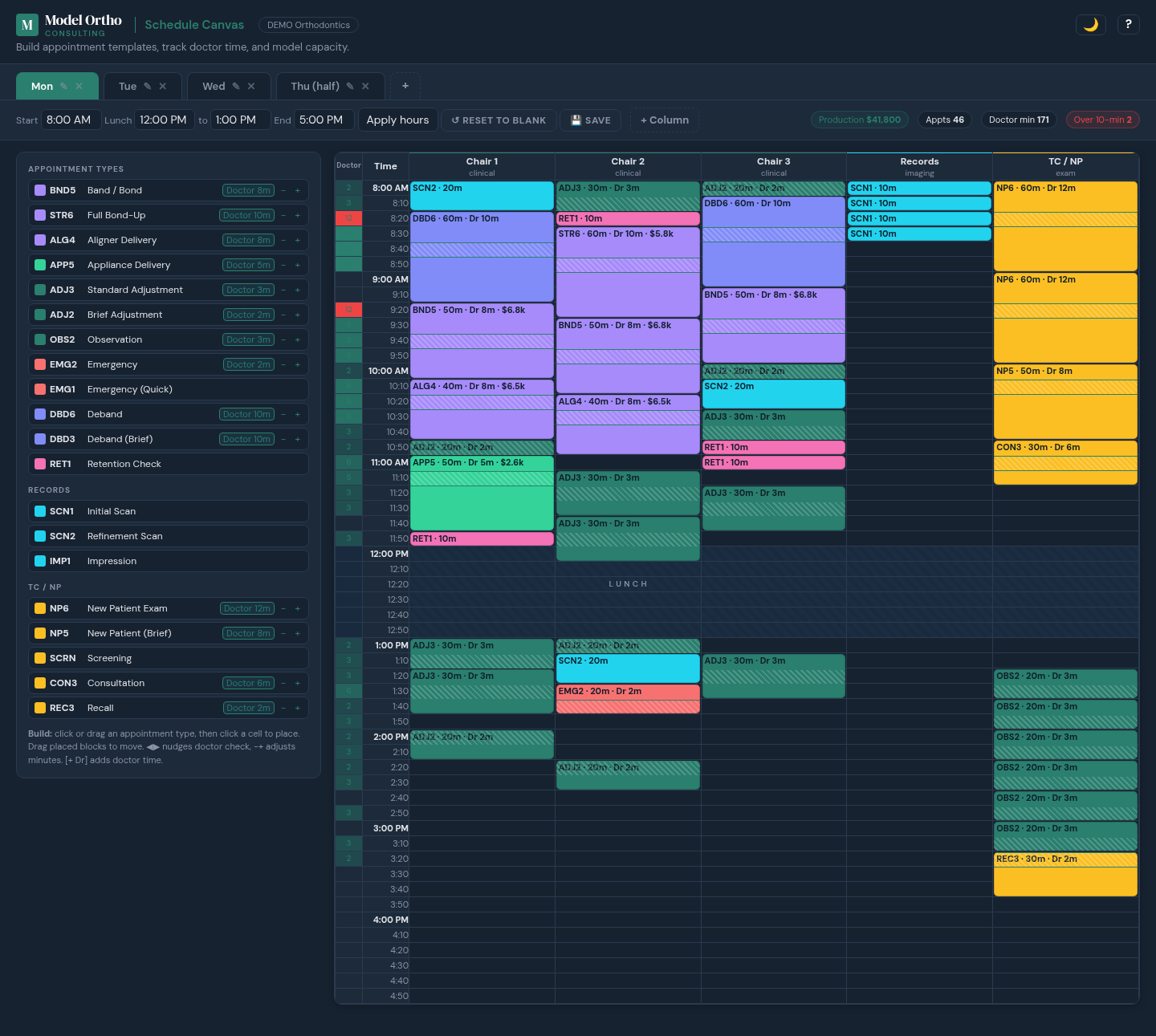
Your schedule is the operational engine of the practice. Each appointment you place cascades through the rest of the system. Schedule Canvas makes those cascades visible.
Read more
This tool models your scheduling patterns against your actual capacity, showing the relationship between how you schedule and what you produce. You can see where capacity is underutilized, where it's overburdened, and how small adjustments to scheduling structure can shift production outcomes without increasing volume.
- Identify underutilized and overburdened capacity across all providers
- Model how scheduling decisions affect daily and monthly production
- Visualize the relationship between appointment types and revenue
- Quantify the production cost of unfilled or mismatched appointments
- See where your schedule produces and where it underperforms
- Make scheduling decisions from your own data
Impact Forecaster
Scenarios & Projections
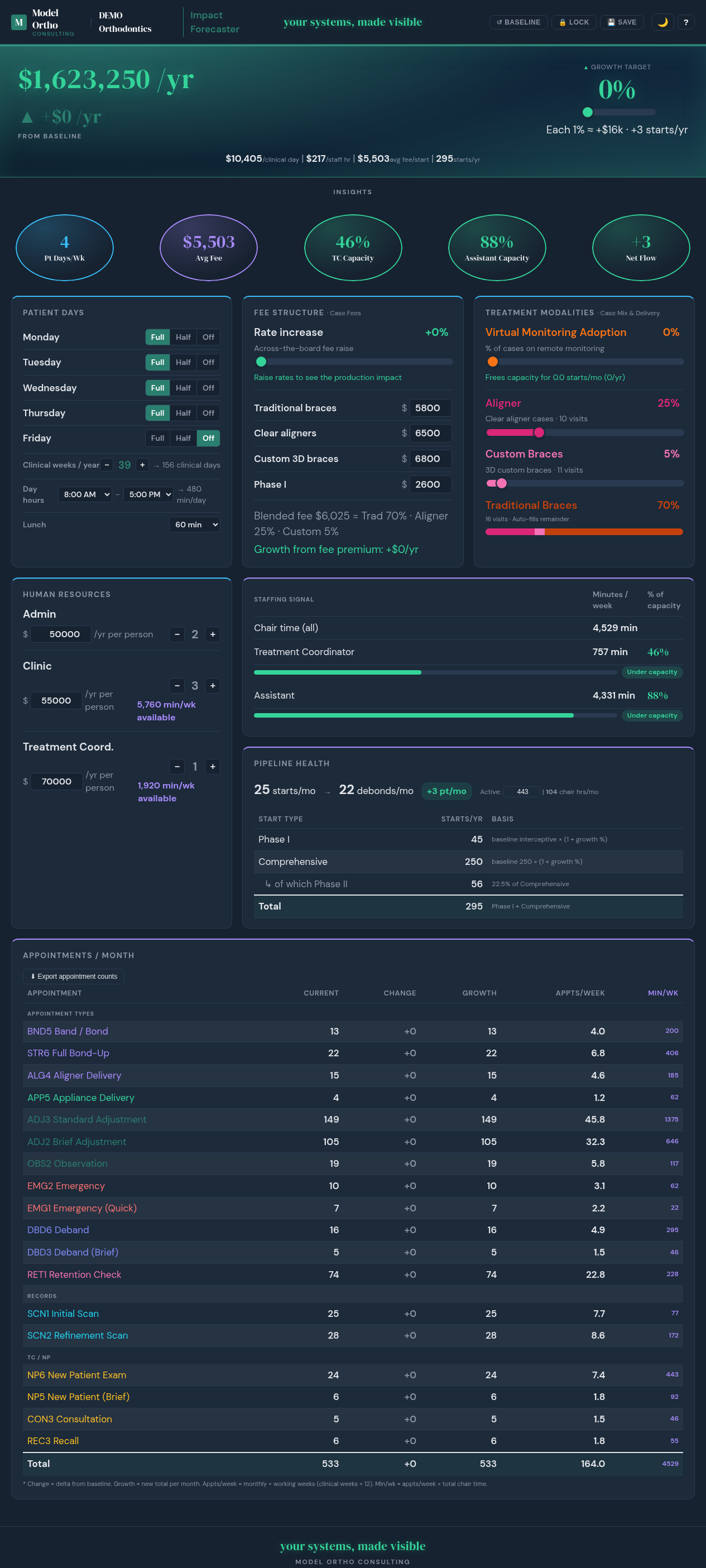
Growth requires capacity, production opportunity, staffing, and operational infrastructure to carry the weight. The Impact Forecaster shows what your practice needs to support the growth you're planning, before you commit to it.
Read more
This tool translates your operational data into forward-looking scenarios. It models different growth trajectories against your current capacity and shows where constraints will appear before they become expensive problems. You can test assumptions: what happens if you add an associate, change your appointment mix, or shift toward aligners? The tool shows the operational requirements of each scenario so you can plan around them.
- Model multiple growth scenarios against current capacity
- Surface operational constraints before they become expensive problems
- Test the impact of adding providers, chairs, or locations
- Model the operational requirements of a growth target
- Project production outcomes under different scheduling structures
- Translate assumptions into numbers you can examine and challenge
Your data, made visible.
You share your practice data. I build the model. You see what the system is doing right now and where it is heading. The tools make the system visible enough that judgment has something real to work with.
I developed the tools I wish I had when I was in business development at a busy orthodontic practice. They model the relationship between scheduling, capacity, production, and growth at the appointment level, grounded in industry benchmarks. Each appointment carries a time, a chair, a provider, and a production value, and the model follows how those choices cascade through the rest of the system. That combination of appointment-level detail and forward projection in one shared model lets you see the binding constraint before it becomes expensive, and test a change before you commit to it.
Getting started is simple. Book a conversation, share a sample of your schedule, and see your own practice modeled. There is nothing to install and nothing to configure on your end.
See the tools in action.
Every engagement starts with real practice data. Your numbers, made visible.